Saturday, 4 November 2017

African Venus by Frank Buchser


Naked Slave with Tambourine (1880)

Agent Triple P is off to Africa for a week, tomorrow, so here is a painting of an African slave girl by Swiss artist Frank (born Franz) Buchser (1828-1890).  Buchser was born near Solothurn and at the age of eighteen was apprenticed to a piano builder, until he was discovered in bed with the piano builder's daughter.  He remained a  great womaniser.


He left Switzerland for Rome where he served as a Swiss Guard at the Vatican to fund his art studies.  He briefly served in Garibaldi's army in 1848.   In the next five years he studied art in Paris, Antwerp and Spain, where his art was really appreciated for the first time.

Spanish gypsy girl with mirror

.In 1858 he travelled to Morocco; a visit which would inspire him to paint some orientalist paintings like the African slave as well as some more conventional scenes where, as ever, he was particularly good at capturing light,

The sadness of Ireland

He spent some time in England and from 1866 to 1879 lived in America, when the Swiss government commissioned him to paint a memorial painting on the subject of the American Civil War (Switzerland had also recently had a civil war).  The painting was never completed but he painted portraits of Grant, Sherman and the last painting done from life of Robert E Lee.   He also painted some striking pictures of the American plains.
This African Slave now hangs in the Kunstmuseum in his home town of Solothurn, along with 80 of his other paintings.

More posts when I return...

Tuesday, 31 October 2017

Halloween Venuses: Witches by Luis Ricardo Falero


Witches going to their Sabbath (1878)


This painting by the Andalusian artist Luis Ricardo Falero (1851-1896) is, without doubt, the greatest painting of witches!  Not only does it feature some of the most voluptuously gorgeous witches ever (the witch in the foreground could raise the dead) but it has bats, flying monsters, ghouls and a goat.


Witches going to their Sabbath, study


Falero studied in Paris (having walked there from Spain) giving up a position in the Spanish Navy.  He eventually settled in London and died there at the young age of forty-five.  


Study of a witch


Falero's painting almost always contained naked or near naked women and often in a fantastical way as with his witches.  Ignoring, on the whole, the wizened crones of earlier times, Falero's witches were all curvaceous, gorgeous women.


Festival of the Witches (1880)


Two points on broom etiquette can be noted in the two paintings above.  Firstly, the witches' brooms are shown as flying brush first, which was the normal way before the more recent rocket-like brush at the rear depiction.  Secondly, his witches avoid any tasteless, sitting astride the broomstick, poses.   In fact this witch is decorously riding side-saddle!

Sunday, 22 October 2017

Venus as mistress: Yvonne Aubicque

Early Morning (1922)


This is an affectionate portrait of Yvonne Aubicque, the mistress of its Irish painter, Sir William Orpen (1878-1931), who has several fascinating stories connected to her.   Called, Early Morning it is a wonderful evocation of the pleasures of a mistress, as she sits surrounded by domestic detritus that indicates no great desire to leave her bed anytime soon.


William Orpen


William Orpen was born in Dublin and attended the Metropolitan School of Art there, to which he was admitted at the age of eleven, such was his natural skill. At the age of seventeen he moved to London to attend the  Slade School of Art.   Catching the attention of John Singer Sargent he rapidly became one of the country's top portrait painters.  Although he married and had three children he had a string of mistresses, many of whom modelled for him, despite constant worries about his own unattractiveness (caused, it is said, by overhearing his parents asking themselves why he was so ugly and their other children so attractive!).  


The Spy/ The Refugee I (1918)


In 1916, Orpen was appointed as an official war artist and carried on in this role after the war, where he was was the official painter of the Versailles treaty signing.  While in France, he fell head over heels for Yvonne Aubicque, the daughter of the Mayor of Lille, who he mat met in hospital, when suffering with blood poisoning, where she was working as a Red Cross volunteer.  He painted two portraits of her during the war but when he sent the paintings back to Britain he found himself in hot water, as official war artists were only supposed to paint pictures of military subjects. 


The Spy/The Refugee II (1917)


Even worse, he had called his pictures of her "The Spy" and claimed she was a German spy who had been executed by the French, no doubt in order to give it an acceptable "military" provenance.  However, the subject of female spies was sensitive at this period as English nurse Edith Cavell had been shot by the Germans for helping allied soldiers to escape and Mata Hari had also just been executed by the French.  Orpen found himself facing a court martial and had to confess that the paintings were of his mistress. One of Orpen's friends was Lord Beaverbrook, who was instrumental in preventing the court martial, although Orpen was severely reprimanded and only just hung on to his official war artist role.  Orpen changed the name of the pictures to The Refugee and, like his war paintings, they now belong to the Imperial War Museum in London.


The Beaverbrooke copy on the Antiques Roadshow


There is an interesting coda to this story.  In 2013 a man brought a picture along to the filming of the BBC show Antiques Roadshow, where members of the public bring along items and a panel of experts tell them about them.  It was a copy of Orpen's The Refugee I.  The owner had taken it to the Imperial War Musem who had said it was just a standard copy. He was not convinced, however, and was puzzled by the high quality of the picture and the fact it was signed Nepro Mailliw (William Orpen written backwards).  He discovered that in 1920 Orpen had gone back to France and painted another version of the painting for Lord Beaverbrook as a thank you for helping him escape the court martial.  The expert on the show confirmed that the picture was indeed a copy but was made by Orpen himself and was the long lost Beaverbrook version.  Much to the owner's shock, he valued it at £250,000.


Yvonne Aubicque in 1918


What happened to the lovely Yvonne?  She remained as Orpen's mistress for more than ten years; although he usually ran more than one mistress simultaneously.  When in France, after the war, he had bought a black Rolls-Royce and hired a sixteen year old called William Grover as his chauffeur.  Grover was the son of an English father and a French mother but had been born in France. He immediately took a fancy to Yvonne and she him.  You might expect all sorts of problems to follow but when Yvonne stopped being Orpen's mistress he gave her his Rolls-Royce and a large house in Paris.  Grover and Yvonne married in 1929.  Grover had always been keen on cars and motorcycles and had started to race motorcycles at the age of fifteen.  Worried about what his father might think, he used the pseudonym W Williams when he started to race. By 1926 he had graduated to car racing.  In 1928 he won the French Grand Prix and in 1929, in a British Racing Green Bugatti, he won the inaugural Monaco Grand Prix.  Now known as Grover-Williams he retired from racing to concentrate on business, including working for Bugatti and running a kennel where Yvonne bred Highland Terriers which she successfully showed at Crufts dog show, eventually becoming a judge there. They were a wealthy couple and, apparently, good dancers, winning several competitions.


Grover Williams leading the 1929 Monaco Grand Prix


With the German invasion of France Grover-Williams fled to Britain where, because of his fluency in both French and English, he was recruited into the Special Operations Executive where he was trained at their wartime base, the home of Lord Montague, Beaulieu in Hampshire, now, coincidentally, the site of the National Motor Museum.  Grover-Williams was dropped into France, with no contacts or support on the ground, and was instructed to set up a new resistance network in Paris, as the previous one had been compromised. Yvonne moved back to Paris as well, although she lived in their house in Rue Weber while he lived in a separate apartment.  He recruited two former fellow racing drivers and they began sabotage work, principally at the Citroen factory.  In August 1943 Grover-Williams was captured by the Germans as their network had been compromised and it was believed that he was interrogated by the Gestapo and shot almost immediately.


Reclining Woman.  Yvonne Aubicque by William Orpen


However, in the 1990's a different story emerged.  It looked as if Grover-Williams survived and was taken to a prison camp in Poland.  It then appears that he joined MI6 after the war.  Even more strangely, in 1948 a man called George Tambal turned up at Yvonne's house in Evreux and moved in with her. She introduced him as her cousin but the locals thought they acted more like lovers.  He claimed to have arrived from America via Uganda, bringing animals for the depleted zoos of Europe. Grover-Williams, it should be noted, had family in America and a sister in Uganda. Also, amazingly, Tambal's date of birth was exactly the same as Grover-Willams'. Tambal was very knowledgeable about motor cars and bore the scars of a beating around the head. 

No-one has ever proved it conclusively but it looks like Grover-Williams survived the war, joined MI6 (MI6 have admitted they know what happened to Grover-Willams but they won't say what) and then rejoined his wife in Evreux.  She died in 1973 and Tambal/Grover-Williams was killed in 1983, at the age of eighty, having been knocked off his bicycle by a car, ironically, driven by a German tourist.


Elements of this remarkable story were used by Robert Ryan in his novel Early One Morning in which a fictionalised version of Yvonne Aubicque appears as Eve Aubique.

Sir William Orpen died in Kensington in 1931, possibly from complications arising from syphilis, and at the time was probably the most famous artist in Britain.

Saturday, 7 October 2017

Harem Venus: A favourite odalisque by Fabbio Fabbi


As I continue to replace some of my old  posts on the former Venus Observations site I am going through a period when I was featuring a lot of harem Venuses.  This very fine example is by by Italian orientalist painter Fabio Fabbi (1861-1946).  It's a strong composition with the pale body of the girl forming one diagonal of the basically St Andrew's cross shaped composition and the dark space the other diagonal: her hip and lower trunk forming the centre of the composition.  She is a confident looking lady, well aware of her position as favourite!


Fabbi was born in Bologna and studied both painting and sculpture in Florence.  In the first half or the 1880s he travelled to Paris and Munich.  It was his visit to Egypt in 1886 which really effected him, however, and on his return to Italy he painted many orientalist subjects and was particularly adept at catching the movement of dancing girls.  


He was commercially very successful and painted many orientalist themed pictures.   Most of his orientalist women are dressed but he produced a few nude odalisque paintings as well as some 'slave for sale' type pictures, which we shall look at shortly.

Wednesday, 4 October 2017

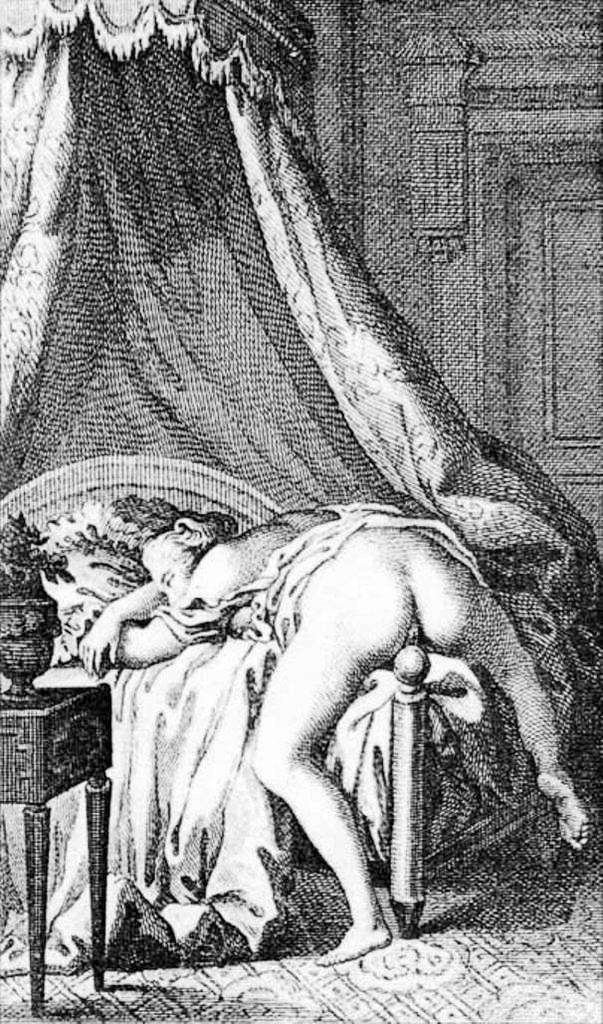
Bedpost Venuses


Here we have three amusing pictures on the same theme; that of an enterprising lady using her bedpost as a convenient dildo.  This first one dates from 1785 and is an illustration by Borel, engraved by Elluin, for an edition of the French novel Thérèse Philosophe (1748), attributed to Jean-Baptiste de Boyer.  As is not uncommon in French erotica (see Emmanuelle) it mixes sexual content with philosophical proselytising.  In this case. the pernicious and hypocritical attitudes of the French church to sex. 


This next one picturee book was published in Germany, several of the plates illustrate men in British Army uniform, from the period of the Charge of the Light Brigade, so it is likely that the anonymous artist was British.  Here, for example, the lady has two military prints hanging on her wall illustrating a trooper of the household cavalry and a soldier from a highland regiment.


Finally, we finish with a photograph from approximately 1887, when striped stockings, such as this, were all the rage, of a lady patently going all the way on her bedpost.  Well done, madame!

Sunday, 1 October 2017

Harem Venus: The Harem Beauty by Francisco Masriera y Manovens

The Harem Beauty (1889)


This confident looking harem lovely is the work of Catalonian artist, writer and goldsmith Francisco Masriera y Manovens (1842-1902).  He first studied under his father, a silversmith, in Barcelona at the age of thirteen. Between 1862 and 1870 he made several trips to Paris, Rome, London and Geneva. By the age of 31 he had his own studio back in Barcelona.

He was a commercially successful painter, alternating between lucrative portraits, genre painting and orientalism; although unlike some other painters of the time he didn't actually travel to the Middle East or North Africa.

He continued with his interest in silver and gold working and a decorative vase he designed won a silver medal at the Paris Exposition of 1889.

Wednesday, 27 September 2017

Venus with a dog 1: By Jean-Honoré Fragonard


Young woman playing with dog (La Gimblette) (c.1770)


 Artists have quite often included dogs in erotic art, not necessarily because of any desire to depict women in intimate congress with them but more, we would suggest, to imply something of the smell of a woman; particularly their nether regions, as we will see in a future post.

Here we have two definitely erotic, but also delicate, works by the French artist Jean-Honoré Fragonard (1732-1806).  Fragonard was born in the world capital of perfume, Grasse.  Originally destined to be a notary, his artistic talent was spotted, as an eighteen year old, by François Boucher and his progress was so rapid that he won the Prix de Rome even before he enrolled in the Academy.  After studying in Rome he became a favourite of the court of Louis XV, producing a number of erotic works for private consumption.  The French Revolution deprived him of his wealthy patrons and he himself felt it sensible to leave Paris for the country, where he continued to paint, contributing to his total of over 550 completed paintings. However, by the time he returned to Paris, a few years before his death, he had been totally forgotten and remained so for many decades.  Now he has been rehabilitated as one of the great masters of French painting and a precursor of the Impressionists.

Fragonard’s approach to this small but distinct genre includes these two paintings, which rely for their erotic effect on conveying a strong tactile sense, in similar poses, revealing the backs of the subjects’ thighs.  

In the top painting, Young Woman Playing with Dog,  the dog is in the shadow, whereas the light in the painting is focussed on that shadowed, suggestive area between her thighs.  The subject was interpreted by several sculptors, including Fragonard's great grandson, Antonin Fragonard (1857-1887).


This picture was also interpreted by several artists and printmakers. In this one, obviously based on a print of the painting as it is reversed, the girl's nether regions are carefully concealed by a sheet.  The dog has changed colour too.


Girl with dog (c. 1770)


The one above, Girl with Dog,  is on display in the Alte Pinakothek in Munich.  The contast between the dog’s fluffy tail and the girl’s inner thighs are, no doubt, the cause of her sweet smile although it is painted in such a way as to (just) allow for a more innocent explanation.


Both paintings are sometimes known as La Gimblette (a sort of pastry) Fragonard produced several versions, some now lost, where the girl is depicted as offering a pastry to the dog.  Considered very risqué at the time, engravings of it were marked “not for display”.


In this version of Fragonard's picture, produced as a miniature, no doubt for a gentleman collector, the dog's tail has been shortened to reveal the tip of its tail just stroking the girl's exposed mound.